Thursday, July 23, 2015

2015 Reading Challenge - Set in the future

Oryx and Crake by Margaret Atwood
Atwood has a way of describing the future that is horrifying and at the same time very plausible and even (here's where it gets really horrifying) inevitable. Calling this an enjoyable read probably isn't accurate, but it had my attention from beginning to end. Jimmy (aka Snowman) may be the only human left on earth after a terrible plague wipes out everyone -- except Snowman himself (who received immunity shots) and the genetically designed creatures that live in the sealed dome where Snowman worked with his brilliant but dangerous best friend Crake. Snowman is left to figure how things got so out of hand, and how he is going to survive. However, I didn't realize when I picked this up that it is one of a series and at the end there is no resolution, just an introduction to the next stage of the story. But I believe I'm hooked. I'm going to have to find out what happens next.

Sunday, July 19, 2015

2015 Reading Challenge -- The Lewis Trilogy


The Lewis Trilogy by Peter May
Lewis Trilogy #1 The Blackhouse
Nothing like a rainy Saturday to delve into a murder mystery set in the cold bleak and dangerous Hebrides Islands. Edinburgh police detective Fin MacLeod is assigned to return to his childhood home to investigate a murder that bears a strong resemblance to a murder in Edinburgh. Here he must face not only a dangerous murderer but also the reasons he left his home decades ago. Loved it and can't wait for Book 2.


Lewis Trilogy #2 The Lewis Man
Another very satisfying, dark murder mystery set in the Hebrides Island north of Scotland. The protagonist, Fen Macleod, has retired from the police force and returned to the Isle of Lewis to renovate his childhood home. His former colleague on the Lewis police force calls on him for advice when a body is found buried in the peat bogs. It's common knowledge that a body buried in peat can be preserved for centuries -- but this one has a tattoo of Elvis on the forearm. Ah Ha! This one has an interesting twist in that one of the possible witnesses to the crime is an elderly man suffering from dementia. His inner memories of the past are quite clear but his interactions with the people in the present are muddled and confused. Now on to the last of this trilogy -- The Chessmen. Can't wait!

Lewis Trilogy #3 The Chessmen
I regret to say that this third installment seemed a little forced. We think we know our hero Fin pretty well and then "Oh by the way I was a roadie for a rock star whose plane disappeared 17 years ago. And one of the members of the group was my best friend who saved my life a couple of times and who still lives on the Isle of Lewis." We thought we knew who your best friend was. Remember Books One and Two? Also, I don't know who characterized this as a trilogy but in my opinion a trilogy should be a story in three parts.  This one clearly leaves the door open for another  installment. So the truth is the rating should probably be 3 stars due to these flaws but I enjoyed being whisked away to The Hebrides Islands for another absorbing mystery among the friends and family of Fin MacLeod. And should there be another installment -- I'm in.

Wednesday, July 15, 2015

2015 Reading Challenge -- Love Triangle

Anna Karenina
I have to say this one really has me scratching my head. This book has been described as "the greatest novel ever written" and a "flawless work of art". The love affair between the title character and her lover Count Vronsky is described as "tragic" and "passionate". If someone had handed me this book and asked me to read and tell them what I thought I would have said it is a scathing satire about the Russian aristocracy. But classic tragic love story? No. I found Anna to be childish, selfish and completely unsympathetic.  Count Vronsky is less annoying, but still ridiculous at times. For starters, these two fall madly passionately forever-and-ever in love across a crowded room.  They literally have barely exchanged 5 sentences before they are willing to endanger Anna's marriage which includes estrangement from her only child for the sake of their romance. Can you say high school?

 She confesses her affair to her husband who after consideration tells her to carry on if she wants to, but to keep it discreet and that Count Vronsky is not allowed in their home. That seems more than reasonable. But of course Anna decides that she can't bear not being with Vronsky and invites him to the house. Childish.

Later in the story Anna abandons her son to take off on a grand tour of Europe with Vronsky and their illegitimate daughter. She then is very surprised when upon their return her husband is hesitant to let her visit the son. Can't say I blame him. While Anna and Vronsky are touring Europe together Vronsky decides he wants to learn to paint. To quote from the book, "Medieval Italian life had at that time become so fascinating to him that he even began to wear his hat and throw his cloak across his shoulder in a medieval manner which was very becoming to him." Ridiculous. During this tour the happy couple visits an up-and-coming artist. They agree that he is very talented, but also agree that his talent could not develop because he does not have the education that they have. Snobs. I don't like them.

At some point Anna reveals that while she misses her abandoned son terribly, she really hasn't formed an emotional bond with her daughter with Vronsky. She begins to tutor a child and develops an emotional bond with that child that seems to exceed her bond with her own daughter. When Vronsky mentions this she flips her lid and accuses him of not loving her. I don't like her. Someone suggests that instead of tutoring one child Anna could tutor at a local orphanage. She replies that she couldn't possibly work with those "dirty orphans". I really don't like her.

After their return, they establish a house in Moscow where Vronsky attempts to create a life for himself. Not so fast, Count. You've forgotten about the love of your life. He finds that he is not allowed to socialize without her, because (again quoting from the book) "one attempt of that kind had produced in Anna an unexpected fit of depression quite disproportionate to the offence of a late supper with some acquaintances." This is not love. This is a grown woman throwing a tantrum. How am I supposed to take these people seriously?

While I appreciate the insight into political and social realm of post-feudal, pre-revolution Russia, I found other characters -- specifically Levin and Kitty -- much more interesting, likeable and believable. I cannot understand why Anna is held up as an example of a classic tragic heroine.

Another classic duly read. I'm glad it's over.

Thursday, June 18, 2015

2015 Reading Challenge -- Book with Antonyms in the Title

Up the Down Staircase
This is the story of an English teacher in her first job in an inner city school. It is an epistolary novel (I confess I didn't know the meaning of that word, but it means "a novel written in a series of documents") -- in this case that means notes she exchanges with one of her fellow teachers, letters she writes to a good friend, memos from the administration at the school, and notes from her students. This school is hopelessly under-supplied, the administration issues directives that can't possibly be fulfilled, and the students have situations at home that break your heart. But it is a story about hope and determination and in the end -- who learns more -- the teacher or the students? 

I happen to live in an area where the schools are very well-funded and so I don't know anything about some of the challenges faced by these characters but I'm willing to bet some of the nonsensical bureaucracy that is described would be familiar to any teacher who happens to read this book. I kind of wish I had read this when my kids were still in school -- I would have been much more sympathetic to what the teachers were facing every day. In fact, I'll bet most teachers would love to make this required reading for all parents enrolling their students in public school.

Friday, June 12, 2015

2015 Reading Challenge -- Finished in a Day

84 Charing Cross Road by Helene Hanff
This delightful little treasure of a book consists of the correspondence between an American free-lance writer and the manager of a used book store in England. Their correspondence and friendship spans 20 years. These letters reveal not only the flamboyant personality of the writer as it contrasts with the natural reticence of her bookstore friend, but also a sense of life in 1950s and 60s New York and London. Highly recommend.

Wednesday, June 10, 2015

2015 Reading Challenge -- Memoir

The Last Lecture by Randy Pausch

This book was not what I expected it to be. The author, Randy Pausch, was a professor at Carnegie Mellon who was one of the driving forces behind virtual reality. He was diagnosed with terminal cancer and had only a few months left to live. He wrote this in an effort to leave a little of himself behind for his family, and specifically his three small children, two of whom were too young to have any real memories of him. He freely admits that he is a highly analytical sort. That much is obvious. I found his writing to be strangely (to me anyway) emotionally detached.

The book is a series of little life lessons. For instance, one chapter is titled "Treat the Disease, Not the Symptoms". This chapter tells the tale of a woman he dated who had a large debt that was causing her stress. She attended a yoga class once a week to alleviate this stress. He advised her to take a part time job instead of attending the class and use the money she made to pay off the debt, thereby alleviating the stress by addressing the problem, not the symptoms. Well, duh. Not exactly mind-blowing stuff. 

 The chapters all have a life lesson -- be prepared, work together. Some of the lessons go a little deeper than that -- enjoy the moment, inject some magic in to the mundane. So I would say it might be useful for someone at the beginning of their adult life but to be honest I found it a little superficial for someone facing the end of their life.

Friday, June 5, 2015

2015 Reading Challenge -- Book Published This Year

The Girl on the Train by Paula Hawkins

First, let me say that I love a good who-done-it. And I also enjoy books in which the narrative point of view shifts from character to character because I enjoy learning how one character's memory or impression of events varies from another character -- even when they may be in the same room at the same time. And I enjoy flawed but sympathetic characters, because as we all know, in real life no one is all good or all bad.

This book has all of the above, and is what I call a real page-turner. There's a difference, of course, between great or even good writing and good story-telling. This book is an example of good story-telling. If I had had the time I could have and would have read this book from cover to cover in one sitting. Is it great writing? No. But it is a compelling story with lots of suspense, and more than a few surprising twists and turns. A nice debut for Ms. Hawkins. It will be interesting to see if her next effort is as enjoyable.

Wednesday, June 3, 2015

2015 Reading Challenge -- A Book Published in the Year You Were Born

Till We Have Faces by C.S. Lewis

A retelling of the Cupid and Psyche myth from the point of view of Psyche's sister Orual. The original myth tells the tale of Psyche, a mortal woman whose beauty rivaled that of Aphrodite. Aphrodite is jealous and sends her son, Cupid, to curse Psyche but he falls in love with her. However, he tells her that she must never light the lamp and look upon his face when they are together. In the original myth Psyche's two sisters are jealous and convince her to disobey Cupid. She is then cast into the wilderness and given impossible tasks to complete. Each time Psyche is given help with the tasks and eventually Cupid and Psyche are reunited,

In this retelling, Orual is the narrator, She is extremely unattractive, and is jealous of Psyche. But she is also obsessed with her sister and wants to keep her for her own. In the retelling, Orual's obsessive love for Psyche is what motivates her to convince Psyche to disobey Cupid, resulting in Psyche's banishment into the wilderness. For most of the rest of Orual's life she mourns and regrets her selfish actions. However, by the end, the gods intervene and at the end of Orual's life she and Psyche are reunited. As in, they are united. As in, they become one and the same person.

I am not familiar with C.S. Lewis' writing (except for The Lion, The Witch and Wardrobe) and I am certainly not familiar with Greek and Roman mythology. So I don't really understand why Lewis felt he needed to rewrite this myth. So the truth is, I filled the "Published in the Year You Were Born" category, but I wish I had picked something else.

Friday, May 29, 2015

2015 Reading Challenge -- A Book You Were Supposed to Read in School but Didn't

Catcher in the Rye by J.D. Salinger

First, a disclaimer. I don't believe there was a book I was supposed to read in school that I didn't read. But this is a book that it seems everyone has read and is part of of the fabric of our culture. But I hadn't read it. So I decided to.

This book is considered to be groundbreaking and gained something of a cult following. So the question I wanted to answer is: Why?

The hero (or anti-hero) is a teenage boy, Holden Caulfield, who comes from what might be called a "good" family with some money.  We know this because he lives in Manhattan and he has just been expelled from his fourth (?) private boarding school. This teenage boy curses and uses slang constantly. He is obsessed with the opposite sex and the act of sex itself. He is completely self-absorbed and has unreasonable expectations about just about everything. He is cynical and distrusts everyone and everything. Sounds like just about every teenager I've ever run across. So what's the big deal?

We have to consider it in the context of the era in which this book was released. The era is post-WWII America. We had just defeated two evil empires, and our soldiers were coming Home Sweet Home to their happy-to-be-housewives and their 2.5 kids who were to be seen and not heard.

And here we have 1) a main character who unashamedly rejects the values of his parents and society in general  [See Sister Carrie] and 2) the narrative style is casual and conversational. These two factors were shocking and dismaying to some, refreshing and delightful to others.

To me, the point is not what Holden is complaining about or whether his parents find out that he has been expelled yet again. The point is that the vast machine that is society will always prevail, individuality be damned.


Monday, May 25, 2015

2015 Reading Challenge -- A Book by an Author You've Never Read Before

Sometimes a Great Notion by Ken Kesey
This book fulfilled the "Author I've Never Read Before" but it is so much more than that. It's been a while since I've thought "this is one of the best books I've ever read". But this books rates a place on my particular "Best Ever" bookshelf. It literally makes me want to write Mr. Kesey a letter and thank him for writing this book. Sadly, Mr. Kesey is no longer with us so it's too late for that.

This is the story of the Stamper family, a prominent family in a Washington state logging town, and what happens when a labor strike pits the family against the rest of the town. But it is also a story of brotherhood, betrayal and vengeance. The narrative style is very unusual. It can vary from the inner thoughts of one character to another character to third person all in the same paragraph. At first this  was a little confusing, but when I realized what was going on I thought -- OK, let's throw our inner tube into this river and hang on for the ride. And what a ride it is. Like the river that plays such a prominent role in the book, sometimes the story thunders with rage, and sometimes it is a calm meandering journey. The cast of characters ranges from Old Henry Stamper --  eccentric, maybe even a little nuts, but beloved by his family to Hank Stamper, his son and the face of the logging company his grandfather started decades ago, to Teddy the bartender, who hopes for bad weather and bad times because that's when his business is good. This book is why I read. A treasure unearthed from the vast library of possibilities. Thank you, Ken Kesey.


Tuesday, May 19, 2015

2015 Reading Challenge -- A Book that Scared You

Salem's Lot by Stephen King
I chose this book to fill the Reading Challenge category "A Book that Scared You". I could have read a book I thought might scare me, but I decided to re-read a book that scared me the first time I read it -- close to 40 years ago. And of course I wondered if it would scare me the second time around.

The first time I read this book I was working in an office and had lots of free time on my hands. So I would bring a book to work and read at my desk. Those were the days. Anyway, I remember that this book frightened me so much that I had to put it away in my desk. There I was, sitting in an office in broad daylight and I had to put the book away and shut the drawer.

So did the fright factor stand the test of time? Short answer -- Kudos to Mr. King. This is as chilling a tale as you will ever run across. Ordinary people living in an small New England town doing ordinary things gradually realize that something is very wrong ... something to do with the old house on the hill. Yes, all the cliches are there -- the old house with a murderous history, mysterious strangers who take up residence there, their mesmerizing stare -- but don't let the familiar vampire story memes lull you into thinking that this story won't send chills up your spine.

When you consciously decide to stop reading a half-hour or so before bed time because you don't want the memories of what you just read to be the last thing on your mind as you try to fall asleep, when you actually feel your heart rate go up while you're reading, when your son asks you if you want him to turn off the lights before he goes up to bed and you say NO! -- because you don't want to have to walk through dark rooms on your way to bed -- that's when you know that King's reputation as the master of horror is well-deserved.

Thursday, May 14, 2015

2015 Reading Challenge -- Debut Novel
The Time Traveler's Wife

When I started this book I had two thoughts: 1) What an intriguing and unusual premise -- a love story about a man (Henry) who travels in time and the woman (Clare) who loves him and accepts the difficulties that come with loving someone who literally disappears and reappears without notice. Not only that, but sometimes Henry is 28 and Clare is 20 and sometimes Henry is 35 and Clare is 6 and sometimes Henry is 40 and Clare is 17; and 2) How in the world is this author going to be able to tell this story in a way that the reader can follow? 

Niffenegger succeeds in solving that potential problem. And the storyline definitely had my attention. But I have to say that I didn't get emotionally attached to these characters for some reason. Maybe I'm just not as much of a romantic as I thought I was. And there were a few incidents in the book that just didn't seem plausible to me. And this is after I accepted the rather implausible premise of the story in the first place.

For instance, the main character, Henry, meets his end after being shot in the stomach during one of his time travels. He then reappears in his own living room during a New Year's Eve party:

"Henry's skin is warm, his eyes are open, staring at me, he is heavy in my arms, so heavy, his pale skin torn apart, red everywhere, ripped flesh framing a secret world of blood. I cradle Henry. There's blood at the corner of his mouth. I wipe it off. Firecrackers explode somewhere nearby.
Gomez says, 'I think we'd better call the police.' "

The next page is a month later. Apparently there has been no legal fallout from this fatal shooting. Henry's wife  Clare, is described as being depressed "past hunger, past vanity, past caring." All very understandable, but there is no mention of how this violent death was resolved in the real world. Are we to believe that just one month later the police investigation has been concluded to the satisfaction of the legal system? That's a leap I just can't make.

 I wanted to love this book but it turns out that I just liked it.

Sunday, May 3, 2015

2015 Reading Challenge -- A Book at the Bottom of Your Reading List

The Night Strangers by Chris Bohjalian
This book landed at the "bottom of my reading list" by sorting the number of stars on my Goodreads.com "to-read" list and choosing the one with the fewest stars. The Goodreads rating system works. This book was just OK.

Think Amityville Horror meets Rosemary's Baby with a sprinkle of Stepford Wives thrown in. A family moves to an old Victorian house in a remote New Hampshire town in order to escape the aftermath of the terrible accident the father has endured through his work. The basic plot line is pretty good I suppose but the actions -- or inactions, actually -- of the characters allow the story line to progress in a way that strained my suspension of belief. And I kept wondering why a story with visits from ghosts still bearing the scars of their demise, including a little girl, a father who is contemplating murder, and the creepy "herbalist" women in the neighborhood who take an inordinate interest in the twins in the family didn't give me so much as one spine shiver.

It had potential, but left me wanting more.

Thursday, April 23, 2015

2015 Reading Challenge -- Book More Than a Hundred Years Old

Candide by Voltaire
OK I admit it. I downloaded some SparkNotes for this book as I was reading it because I wanted to be sure I was picking up what Voltaire was laying down. It is clear from the very first page that Voltaire is sticking it to the powers that be. Here we are introduced to the Baron, Candide’s father:

He was called "My Lord" by all his people, and he never told a story but everyone laughed at it.

And that’s just the beginning. Much later in the book Candide and his companion find themselves in the fantastic land of El Dorado, where children play in the streets with gold nuggets and rubies. His companion asks a village elder about religion and asks to meet one of their priests:

"My friend," said he, "we are all priests. The King and all the heads of families sing solemn canticles of thanksgiving every morning, accompanied by five or six thousand musicians."

"What! have you no monks who teach, who dispute, who govern, who cabal, and who burn people that are not of their opinion?"

You get the idea. I was surprised that Voltaire was able to get away with this, until I read that he was imprisoned and exiled on various occasions. But apparently his wit and intelligence literally saved his life.

The sarcasm just oozes in every paragraph as Voltaire skewers religion, the government, and especially the philosophy of optimism which became popular during The Enlightment. Candide was living a sheltered life in his father’s castle and was educated by his tutor Pangloss who teaches him that “everything is for the best” and that we are living “in the best of all possible worlds”. Because with God in Heaven looking over us, any other point of view would suggest that God is imperfect. Then life intervenes. Candide is witness to murder, rape, terrible cruelty and disregard for life, shipwrecks and earthquakes among other disasters. He perseveres, however, convincing himself that all that he is experiencing is “for the best”.

Finally even his tutor Pangloss has to admit that the world is not perfect. The main characters meet a farmer who tells them: “Our labour preserves us from three great evils -- weariness, vice, and want.” And Candide speaks the last and possibly most famous line from the book: "That is good," replied Candide. "Let us cultivate our garden."

Sunday, April 19, 2015

2015 Reading Challenge -- Book Recommended by a Friend

Big Little Lies
This is my first Liane Moriarty book but definitely not my last. As the story begins, there's been a murder, but the victim is not identified. Rewind to six months before the incident, and we are introduced to a community of women who are connected through their children. Each one has a sad secret, each one tells "little lies" that turn out to be -- yes, "big little lies". The characters are revealed through each one's inner thoughts as they navigate the waters of elementary school politics while dealing with ex-husbands, new wives, domestic violence, cliques, playground bullying, and projects that are due tomorrow. Their experiences are sometimes funny, sometimes heartbreaking and always believable. Time to decide which Moriarty book is next on my list!

Wednesday, April 15, 2015

Book review of In the Presence of the Enemy by Elizabeth George

In the Presence of the Enemy by Elizabeth George
This is #8 in the Inspector Lynley series. There have been some definite ups and downs in this series, but I'd say this one is pretty good. Regarding this series -- I enjoy the mysteries themselves and I also find most of the recurring characters interesting. Scotland Yard Inspector Lynley, 8th Earl of Asherton, and his blue-collar co-worker Sargent Barbara Havers play off of each other very nicely. His best friend Simon St. James, a forensic scientist and his photographer wife Deborah round out the cast of characters. The other regular character, Lady Helen Clyde is Lynley's sometimes girlfriend. Lynley is madly in love with Helen. She tells him she loves him but doesn't know if she wants to marry him. She says she's worried that her perfect little world might not be always and constantly perfect if they get married. Please. I would say that any fan of English cozy mysteries will enjoy this series if they can get past the annoying Lady Helen.

In this installment of the Lynley series, the forensic scientist St. James, his wife Deborah and Lady Helen take it upon themselves to investigate the abduction and kidnapping of a child without bothering to tell their respective best friend / sort-of fiance who happens to be a revered and respected investigator with Scotland Yard. Tragically the child is murdered, and Lynley is understandably outraged when he discovers that his friends deliberately kept him uninformed. He lashes out at his friends and fiancee, and predictably Helen pouts, refuses to return his calls and eventually agrees to forgive him. Huh? I find it hard to understand why an intelligent perceptive man like Lynley would put up with this adolescent nonsense. But he does. The rest of the story plays out with interesting twists and turns and plenty of suspense until the murderer is identified and brought to justice. I still intend to finish the series in spite of the very silly Helen and the inexplicable devotion of Inspector Lynley. But I am addicted to who-dunnits.

Saturday, April 11, 2015

2015 Reading Challenge -- Book that was made into a movie

Strangers on a Train by Patricia Highsmith

This book, the inspiration for the classic Hitchcock film of the same name, begins with a chance meeting on a train. Guy Haines, an architect whose career is on the verge of blossoming into greatness, is traveling to meet his wife and negotiate a divorce so he can marry the woman of his dreams. Charles Bruno is a spoiled rich kid who also happens to be an alcoholic psychopath. They share drinks, and then confidences. Haines speaks of his wife, a serial cheater who refuses to cooperate about the divorce. Bruno speaks of his father, who (according to Bruno) refuses to give him access to the money that is rightfully his. The suspense builds from this encounter as Bruno and his madness insinuate themselves into Haines' life with tragic and inevitable results. As with many stories that stand the test of time, this one prompts a few existential questions. Are there good people and evil people or is there good and evil in everyone? And specific to this story, is anyone -- any "Guy" -- capable of murder given the right circumstances? Can a person be driven to madness by another's madness? Before you say certainly not I -- give this classic thriller a read. You may change your mind.

Tuesday, April 7, 2015

2015 Reading Challenge -- Book with Nonhuman Characters

A Discovery of Witches by Deborah Harkness
I would characterize this book as Nora Roberts meets Twilight. To some, that puts this book at the top of their "to-read" list and for others, right into the "not worthy of my time" pile. I'd say I'm somewhere in the middle. This is the story of a young woman from a storied line of witches going back to Salem and beyond who falls in love with an impossibly handsome vampire -- in the Bodleian Library at Oxford, no less. Complicating matters is the fact that she does not want to acknowledge her witchiness, and the fact that vampires and witches have been forbidden by the Congregation to associate, much less fall in love. There were some interesting twists and it was an entertaining read, I suppose. It did bother me (as it always does in these situations) that the end of the book (#1 of a trilogy) is not a conclusion, but a lead-in to the next volume in the series. I may go back and see what happens to Diana and Matthew. But there are miles of books to read before I sleep.

Monday, March 30, 2015

2015 Reading Challenge - Book Set in Another Country


The Beautiful Mystery by Louise Penny
Another masterfully woven tale. This time Louise Penny takes us not to the village of Three Pines, but to a heretofore unknown order of monks cloistered in a secret monastery on an island. Inspector Gamache and his troubled second-in-command Jean-Guy Beauvoir must determine who murdered the choir master of a sect whose very existence is rooted in music. Who among these peaceful men of God killed one of their brothers? What part does the music play in the motive? Convincing monks who have taken a vow of silence to divulge information is difficult enough, but the task becomes even more difficult with the arrival of the sinister Superintendent Sylvain Francoeur, who is as dangerous as any murderer. Will good prevail over evil? Only time will tell.

Wednesday, March 25, 2015

2015 Reading Challenge -- Book More Than 500 Pages

Here Be Dragons by Sharon Kay Penman
"There is no frigate like a book to take us worlds away ..." I found this quote on a bookmark while reading this book and thought how appropriate it was. This is truly historical fiction as it features King John of England (son of Eleanor of Aquitaine, brother of Richard the Lionhearted) and his bastard daughter Joanna who marries Prince Llewelyn of Wales at the age of 15. The story focuses on Joanna and the conflicts that arise as the interests of her father and husband inevitably clash. There are grudges that last for generations, and enough half-brothers and arranged marriages between warring families to make your head spin. Fair warning -- I had to write a diagram of all the relationships to keep everyone straight. But Penman's research and attention to detail made me feel as though I gained an understanding not only of the impact of the marriages, births and deaths of these people but also of what their daily life was like.

Thursday, March 19, 2015

2015 Reading Challenge -- Pulitzer Prize Winner -- The Goldfinch -- Review

The Goldfinch by Donna Tartt
Put me down on the "I liked it" side of the tally board. I think what impressed me the most was the ability of the author, a 50-ish woman born and raised in Mississippi, to convince me that I was reading the thoughts of a 13-year old boy living in Manhattan, who has endured a terrible loss, who suffers from depression and addiction, whose life is not so much a roller coaster as an endless carnival fun house. That, and the question that hovers over this story: "What if?" That's a question we've all asked ourselves time and time again, but The Goldfinch asks the question on a much deeper level than "what if I had taken that job". For instance:

“Well -- think about this. What if all your actions and choices, good or bad, make no difference to God? What if the pattern is pre-set? No no -- hang on -- this is a question worth struggling with. What if our badness and mistakes are the very thing that set our fate and bring us round to good? What if, for some of us, we can't get there any other way?”

Huh. What if, indeed?

I suppose 770 pages seems like alot. But I have been known to skim when the sheer length of a book has made my eyes glaze over. And not once did I think about skimming this book.

Tuesday, March 17, 2015

Good Writing

The Goldfinch by Donna Tartt
page 79

Mrs. Barbour was from a society family with an old Dutch name, so cool and blonde and monotone that sometimes she seemed partially drained of blood. She was a masterpiece of composure; nothing ever ruffled her or made her upset, and though she was not beautiful her calmness had the magnetic pull of beauty -- a stillness so powerful that the molecules realigned themselves around her when she came into a room.

page 476

None of this was as bad as I'd feared. But what I hadn't expected to hit even a quarter so hard was what Mya called "the mental stuff," which was unendurable, a sopping black curtain of horror.

But depression wasn't the word. This was a plunge encompassing sorrow and revulsion far beyond the personal: a sick, drenching nausea at all humanity and human endeavor from the dawn of time.

page 745 -- Boris

Well -- I have to say I personally have never drawn such a sharp line between "good" and "bad" as you. For me: that line is often false. The two are never disconnected. One can't exist without the other. As long as I am acting out of love, I feel I am doing best I knowhow. But you -- wrapped up in judgment, always regretting the past, cursing yourself, blaming yourself, asking "what if," "what if." "Life is cruel." "I wish I had died instead of." Well -- think about this. What if all your actions and choices, good or bad, make no difference to God? What if the pattern is pre-set? No no -- hang on -- this is a question worth struggling with. What if our badness and mistakes are the very thing that set our fate and bring us round to good? What if, for some of us, we can't get there any other way?

page 758 -- Hobie

" ... if a painting really works down in your heart and changes the way you see, and think, and feel, you don't think, "oh, I love this picture because it's universal." "I love this painting because it speaks to all mankind." That's not the reason anyone loves a piece of art. It's a secret whisper from an alleyway. "Psst, you. Hey kid. Yes you."

You see one painting, I see another, the art book puts it another remove still, the lady buying the greeting card at the museum gift shop sees something else entirely, and that's not even to mention the people separated from us by time -- four hundred years before us, four hundred years after we're gone -- it'll never strike anybody the same way and the great majority of people it'll never strike in any deep way at all but -- a really great painting is fluid enough to work its way into the mind and heart through all kinds of different angles, in ways that are unique and very particular.

Candide by Voltaire - Published 1759

page 86

“The Dutch fetishes who converted me tell me every Sunday that the blacks and whites are all children of one father, whom they call Adam. As for me, I do not understand anything of genealogies; but if what these preachers say is true, we are all second cousins; and you must allow that it is impossible to be worse treated by our relations than we are.”

page 154

The little society, one and all, entered into this laudable design and set themselves to exert their different talents. The little piece of ground yielded them a plentiful crop. Cunegund indeed was very ugly, but she became an excellent hand at pastry work: Pacquette emroidered; the old woman had the care of the lilnen. There was non, down to Brother Grioflee, but did some service; he was a very good carpenter, and became an honest man. 
...
"Excellently observed," answered Candide; "but let us cultivate our garden."

The Catcher in the Rye by J. D Salinger

page 205

“It's funny. All you have to do is say something nobody understands and they'll do practically anything you want them to.” 
― J.D. SalingerThe Catcher in the Rye

Friday, March 13, 2015

2015 Reading Challenge – Based on a True Story


Operation Mincemeat: How a Dead Man and a Bizarre Plan Fooled the Nazis and Assured an Allied Victory

Truth is stranger than fiction? Truth is better than fiction. In 1943, Ewan Montagu, a British naval intelligence officer, and Charles Cholmondeley of MI5 come up with a daring, outrageous plan to float a dead body carrying false intelligence onto the shores of Spain in the hopes that it will fall into German hands. Montagu chronicled his adventures in a book called The Man That Never Was, which was also made into a movie. After Montagu’s death in 1985 McIntyre was given access to Montagu’s personal papers, and so began Operation Mincemeat -- the story behind the story. The British intelligence officer whose brother is a spy for Russia, the Welsh coal miner who played the lead role after he was dead, the genial undertaker, the Spanish authorities who weren’t as corrupt as the British hoped, the ambitious but somewhat dim German intelligence officer – all these characters and more combine in a tale of deception that changed the course of history. Written like a novel, it is all the more enjoyable as the story is backed up by photographs and even a Photostat of the original written plan. Highly recommend. 

Friday, March 6, 2015

2015 Reading Challenge -- A Book I Started Previously but Didn't Finish - Review

2015 Reading Challenge -- A Book I Started Previously but Didn't Finish
Sister Carrie by Theodore Dreiser

Sister Carrie is a young woman who travels alone from a small town to the big city, Chicago, in 1889. This book, published in 1900, was considered shocking at the time due to the unconventional behavior of the title character. The narrative intertwines the story line with remarks about the human condition, such as “Our civilization is still in a middle age – scarcely beast, in that it is no longer wholly guided by instinct; scarcely human, in that is not wholly guided by reason.” . I suppose I understand why this book is a milestone in popular fiction due to the fact that the heroine is not doomed to a life of abandonment and misery even though she flaunts all the rules of what is considered decency at the time.  I must confess, however,  that the verbose style of writing along with the tendency of Dreiser to give detailed descriptions of interactions with characters never to be seen again meant that on or about page 500 of this 600 page book I began to skim just to get through it. So I can check this one off – “one of the most influential American novels” – duly read.

2015 Reading Challenge - Nonfiction Review


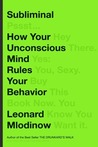
Subliminal: How Your Unconscious Mind Rules Your BehaviorSubliminal: How Your Unconscious Mind Rules Your Behavior by Leonard Mlodinow
My rating: 3 of 5 stars

Subliminal: How Your Unconscious Mind Rules Your Behavior
2015 Reading Challenge – Nonfiction
Written for those untrained in the science of our brain and how it works, Mlodinow presents examples and explanations of how our “unconscious” mind affects our daily life. From simple categorizations that allow us to survive (bigger than me, large teeth, long claws = get away NOW without stopping to consider whether it’s a mountain lion or a bear) to the way the brain fills in the missing pieces of a drawing to see a complete image, to the power of vested interest when we decide which political candidate to vote for, our unconscious brain is the driving engine behind every minute of our day. The inclusion of specific examples of research done on the subject along with humorous hypothetical situations make the concepts very easy to understand and enjoyable to read. I think I might read another.


View all my reviews