Monday, March 30, 2015
2015 Reading Challenge - Book Set in Another Country
The Beautiful Mystery by Louise Penny
Another masterfully woven tale. This time Louise Penny takes us not to the village of Three Pines, but to a heretofore unknown order of monks cloistered in a secret monastery on an island. Inspector Gamache and his troubled second-in-command Jean-Guy Beauvoir must determine who murdered the choir master of a sect whose very existence is rooted in music. Who among these peaceful men of God killed one of their brothers? What part does the music play in the motive? Convincing monks who have taken a vow of silence to divulge information is difficult enough, but the task becomes even more difficult with the arrival of the sinister Superintendent Sylvain Francoeur, who is as dangerous as any murderer. Will good prevail over evil? Only time will tell.
Wednesday, March 25, 2015
2015 Reading Challenge -- Book More Than 500 Pages
Here Be Dragons by Sharon Kay Penman
"There is no frigate like a book to take us worlds away ..." I found this quote on a bookmark while reading this book and thought how appropriate it was. This is truly historical fiction as it features King John of England (son of Eleanor of Aquitaine, brother of Richard the Lionhearted) and his bastard daughter Joanna who marries Prince Llewelyn of Wales at the age of 15. The story focuses on Joanna and the conflicts that arise as the interests of her father and husband inevitably clash. There are grudges that last for generations, and enough half-brothers and arranged marriages between warring families to make your head spin. Fair warning -- I had to write a diagram of all the relationships to keep everyone straight. But Penman's research and attention to detail made me feel as though I gained an understanding not only of the impact of the marriages, births and deaths of these people but also of what their daily life was like.
Thursday, March 19, 2015
2015 Reading Challenge -- Pulitzer Prize Winner -- The Goldfinch -- Review
The Goldfinch by Donna Tartt
Put me down on the "I liked it" side of the tally board. I think what impressed me the most was the ability of the author, a 50-ish woman born and raised in Mississippi, to convince me that I was reading the thoughts of a 13-year old boy living in Manhattan, who has endured a terrible loss, who suffers from depression and addiction, whose life is not so much a roller coaster as an endless carnival fun house. That, and the question that hovers over this story: "What if?" That's a question we've all asked ourselves time and time again, but The Goldfinch asks the question on a much deeper level than "what if I had taken that job". For instance:
“Well -- think about this. What if all your actions and choices, good or bad, make no difference to God? What if the pattern is pre-set? No no -- hang on -- this is a question worth struggling with. What if our badness and mistakes are the very thing that set our fate and bring us round to good? What if, for some of us, we can't get there any other way?”
Huh. What if, indeed?
I suppose 770 pages seems like alot. But I have been known to skim when the sheer length of a book has made my eyes glaze over. And not once did I think about skimming this book.
Put me down on the "I liked it" side of the tally board. I think what impressed me the most was the ability of the author, a 50-ish woman born and raised in Mississippi, to convince me that I was reading the thoughts of a 13-year old boy living in Manhattan, who has endured a terrible loss, who suffers from depression and addiction, whose life is not so much a roller coaster as an endless carnival fun house. That, and the question that hovers over this story: "What if?" That's a question we've all asked ourselves time and time again, but The Goldfinch asks the question on a much deeper level than "what if I had taken that job". For instance:
“Well -- think about this. What if all your actions and choices, good or bad, make no difference to God? What if the pattern is pre-set? No no -- hang on -- this is a question worth struggling with. What if our badness and mistakes are the very thing that set our fate and bring us round to good? What if, for some of us, we can't get there any other way?”
Huh. What if, indeed?
I suppose 770 pages seems like alot. But I have been known to skim when the sheer length of a book has made my eyes glaze over. And not once did I think about skimming this book.
Tuesday, March 17, 2015
Good Writing
The Goldfinch by Donna Tartt
page 79
Mrs. Barbour was from a society family with an old Dutch name, so cool and blonde and monotone that sometimes she seemed partially drained of blood. She was a masterpiece of composure; nothing ever ruffled her or made her upset, and though she was not beautiful her calmness had the magnetic pull of beauty -- a stillness so powerful that the molecules realigned themselves around her when she came into a room.
page 476
None of this was as bad as I'd feared. But what I hadn't expected to hit even a quarter so hard was what Mya called "the mental stuff," which was unendurable, a sopping black curtain of horror.
But depression wasn't the word. This was a plunge encompassing sorrow and revulsion far beyond the personal: a sick, drenching nausea at all humanity and human endeavor from the dawn of time.
page 745 -- Boris
Well -- I have to say I personally have never drawn such a sharp line between "good" and "bad" as you. For me: that line is often false. The two are never disconnected. One can't exist without the other. As long as I am acting out of love, I feel I am doing best I knowhow. But you -- wrapped up in judgment, always regretting the past, cursing yourself, blaming yourself, asking "what if," "what if." "Life is cruel." "I wish I had died instead of." Well -- think about this. What if all your actions and choices, good or bad, make no difference to God? What if the pattern is pre-set? No no -- hang on -- this is a question worth struggling with. What if our badness and mistakes are the very thing that set our fate and bring us round to good? What if, for some of us, we can't get there any other way?
page 758 -- Hobie
" ... if a painting really works down in your heart and changes the way you see, and think, and feel, you don't think, "oh, I love this picture because it's universal." "I love this painting because it speaks to all mankind." That's not the reason anyone loves a piece of art. It's a secret whisper from an alleyway. "Psst, you. Hey kid. Yes you."
You see one painting, I see another, the art book puts it another remove still, the lady buying the greeting card at the museum gift shop sees something else entirely, and that's not even to mention the people separated from us by time -- four hundred years before us, four hundred years after we're gone -- it'll never strike anybody the same way and the great majority of people it'll never strike in any deep way at all but -- a really great painting is fluid enough to work its way into the mind and heart through all kinds of different angles, in ways that are unique and very particular.
Candide by Voltaire - Published 1759
page 79
Mrs. Barbour was from a society family with an old Dutch name, so cool and blonde and monotone that sometimes she seemed partially drained of blood. She was a masterpiece of composure; nothing ever ruffled her or made her upset, and though she was not beautiful her calmness had the magnetic pull of beauty -- a stillness so powerful that the molecules realigned themselves around her when she came into a room.
page 476
None of this was as bad as I'd feared. But what I hadn't expected to hit even a quarter so hard was what Mya called "the mental stuff," which was unendurable, a sopping black curtain of horror.
But depression wasn't the word. This was a plunge encompassing sorrow and revulsion far beyond the personal: a sick, drenching nausea at all humanity and human endeavor from the dawn of time.
page 745 -- Boris
Well -- I have to say I personally have never drawn such a sharp line between "good" and "bad" as you. For me: that line is often false. The two are never disconnected. One can't exist without the other. As long as I am acting out of love, I feel I am doing best I knowhow. But you -- wrapped up in judgment, always regretting the past, cursing yourself, blaming yourself, asking "what if," "what if." "Life is cruel." "I wish I had died instead of." Well -- think about this. What if all your actions and choices, good or bad, make no difference to God? What if the pattern is pre-set? No no -- hang on -- this is a question worth struggling with. What if our badness and mistakes are the very thing that set our fate and bring us round to good? What if, for some of us, we can't get there any other way?
page 758 -- Hobie
" ... if a painting really works down in your heart and changes the way you see, and think, and feel, you don't think, "oh, I love this picture because it's universal." "I love this painting because it speaks to all mankind." That's not the reason anyone loves a piece of art. It's a secret whisper from an alleyway. "Psst, you. Hey kid. Yes you."
You see one painting, I see another, the art book puts it another remove still, the lady buying the greeting card at the museum gift shop sees something else entirely, and that's not even to mention the people separated from us by time -- four hundred years before us, four hundred years after we're gone -- it'll never strike anybody the same way and the great majority of people it'll never strike in any deep way at all but -- a really great painting is fluid enough to work its way into the mind and heart through all kinds of different angles, in ways that are unique and very particular.
page 86
“The Dutch fetishes who converted me tell me every Sunday that the blacks and whites are all children of one father, whom they call Adam. As for me, I do not understand anything of genealogies; but if what these preachers say is true, we are all second cousins; and you must allow that it is impossible to be worse treated by our relations than we are.”
page 154
The little society, one and all, entered into this laudable design and set themselves to exert their different talents. The little piece of ground yielded them a plentiful crop. Cunegund indeed was very ugly, but she became an excellent hand at pastry work: Pacquette emroidered; the old woman had the care of the lilnen. There was non, down to Brother Grioflee, but did some service; he was a very good carpenter, and became an honest man.
...
"Excellently observed," answered Candide; "but let us cultivate our garden."
The Catcher in the Rye by J. D Salinger
page 205
“It's funny. All you have to do is say something nobody understands and they'll do practically anything you want them to.”
― J.D. Salinger, The Catcher in the Rye
The Catcher in the Rye by J. D Salinger
page 205
“It's funny. All you have to do is say something nobody understands and they'll do practically anything you want them to.”
― J.D. Salinger, The Catcher in the Rye
Friday, March 13, 2015
2015 Reading Challenge – Based on a True Story
Operation Mincemeat: How a Dead Man and a Bizarre Plan Fooled the Nazis and Assured an Allied Victory
Truth is stranger than fiction? Truth is better than fiction. In 1943, Ewan Montagu, a British naval intelligence officer, and Charles Cholmondeley of MI5 come up with a daring, outrageous plan to float a dead body carrying false intelligence onto the shores of Spain in the hopes that it will fall into German hands. Montagu chronicled his adventures in a book called The Man That Never Was, which was also made into a movie. After Montagu’s death in 1985 McIntyre was given access to Montagu’s personal papers, and so began Operation Mincemeat -- the story behind the story. The British intelligence officer whose brother is a spy for Russia, the Welsh coal miner who played the lead role after he was dead, the genial undertaker, the Spanish authorities who weren’t as corrupt as the British hoped, the ambitious but somewhat dim German intelligence officer – all these characters and more combine in a tale of deception that changed the course of history. Written like a novel, it is all the more enjoyable as the story is backed up by photographs and even a Photostat of the original written plan. Highly recommend.
Friday, March 6, 2015
2015 Reading Challenge -- A Book I Started Previously but Didn't Finish - Review
2015 Reading Challenge -- A Book I Started Previously but Didn't Finish
Sister Carrie by Theodore Dreiser
Sister Carrie is a young woman who travels alone from a small town to the big city, Chicago, in 1889. This book, published in 1900, was considered shocking at the time due to the unconventional behavior of the title character. The narrative intertwines the story line with remarks about the human condition, such as “Our civilization is still in a middle age – scarcely beast, in that it is no longer wholly guided by instinct; scarcely human, in that is not wholly guided by reason.” . I suppose I understand why this book is a milestone in popular fiction due to the fact that the heroine is not doomed to a life of abandonment and misery even though she flaunts all the rules of what is considered decency at the time. I must confess, however, that the verbose style of writing along with the tendency of Dreiser to give detailed descriptions of interactions with characters never to be seen again meant that on or about page 500 of this 600 page book I began to skim just to get through it. So I can check this one off – “one of the most influential American novels” – duly read.
Sister Carrie by Theodore Dreiser
Sister Carrie is a young woman who travels alone from a small town to the big city, Chicago, in 1889. This book, published in 1900, was considered shocking at the time due to the unconventional behavior of the title character. The narrative intertwines the story line with remarks about the human condition, such as “Our civilization is still in a middle age – scarcely beast, in that it is no longer wholly guided by instinct; scarcely human, in that is not wholly guided by reason.” . I suppose I understand why this book is a milestone in popular fiction due to the fact that the heroine is not doomed to a life of abandonment and misery even though she flaunts all the rules of what is considered decency at the time. I must confess, however, that the verbose style of writing along with the tendency of Dreiser to give detailed descriptions of interactions with characters never to be seen again meant that on or about page 500 of this 600 page book I began to skim just to get through it. So I can check this one off – “one of the most influential American novels” – duly read.
2015 Reading Challenge - Nonfiction Review
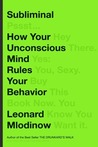
Subliminal: How Your Unconscious Mind Rules Your Behavior by Leonard MlodinowMy rating: 3 of 5 stars
Subliminal: How Your Unconscious Mind Rules Your Behavior
2015 Reading Challenge – Nonfiction
Written for those untrained in the science of our brain and how it works, Mlodinow presents examples and explanations of how our “unconscious” mind affects our daily life. From simple categorizations that allow us to survive (bigger than me, large teeth, long claws = get away NOW without stopping to consider whether it’s a mountain lion or a bear) to the way the brain fills in the missing pieces of a drawing to see a complete image, to the power of vested interest when we decide which political candidate to vote for, our unconscious brain is the driving engine behind every minute of our day. The inclusion of specific examples of research done on the subject along with humorous hypothetical situations make the concepts very easy to understand and enjoyable to read. I think I might read another.
View all my reviews
Subscribe to:
Comments (Atom)